

From The Tide of Deception: Mystery on the Coast of Maine

by Steven James Hantzis
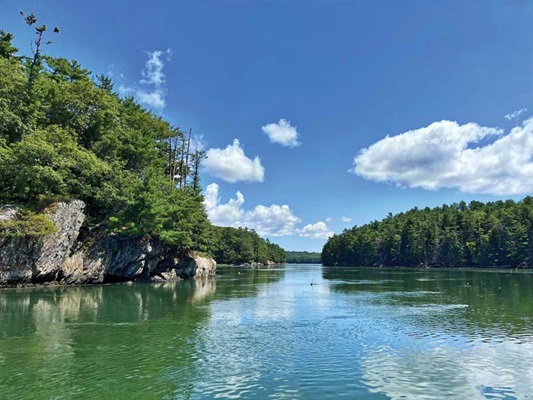
Ovens Mouth, Boothbay, Maine

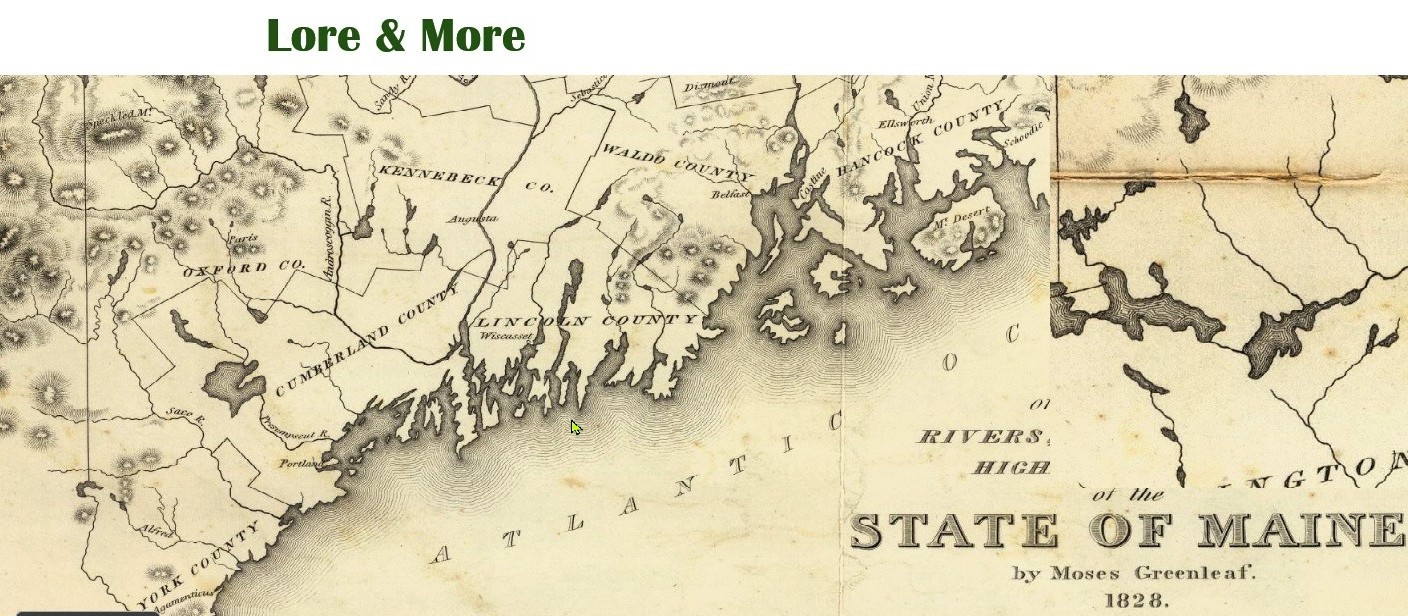
We love our house on Barters Island, and we’re lucky enough to have deep water. We keep our 25-foot C-Dory, Catleen, on our float. One of the easy-to-get-to destinations, only minutes away, is a narrow passage called Oven’ Mouth. Through this thousand-yard gut, tidal currents fill and empty a sizable estuary of Back River. At its narrowest, the passage between land reduces to 150 feet, and the navigable channel is even narrower. The current runs six knots with the changing tides. When piloting a boat and traveling with the current, your speed must be faster than the current to maintain control of your vessel. Otherwise, you become buoyant debris at the hydrologic whims of nature.

Wabanaki Native Americans used Oven’s Mouth as a shortcut between the Damariscotta and Sheepscot Rivers in pre-colonial times. They paddled birchbark canoes down the Damariscotta, then portaged west through the pines and oaks across what is now the Dolphin Mini Golf attraction. At Oven’s Mouth, they paddled to the chilly Sheepscot. This route saved them the longer journey via the choppy mouth of the Damariscotta, across broad Boothbay Harbor, then through Townsend Gut to the Sheepscot. Along their journey, these hunter-gatherers foraged through varied eco-cultures, enjoying the buffet.

Maine has a long history of getting places by water. Water was conveyance long before roads. Overwater moved the shore’s bounty: deer and beaver pelts and luxurious hides of marten, otter, ermine, fisher, and fox. Intricate brown ash basketry and other barterable items made their way to Native American markets along the free-flowing streams, rivers, and coastal routes. When Europeans arrived, water moved the men and ships, who enforced new rules of trade.

For the Wabanaki, Oven’s Mouth was more than just a shortcut. It was a sacred place, a place of spirits that protected and guided them. As they paddled in the narrow channel to the Sheepscot, they sang songs of gratitude to the spirits, the earth, and the water.

On September 9, 1777, as the sun dipped beyond the western shore of the Sheepscot, a clan of Wabanaki hunters pulled their canoes through a muddy flat. Wading in muck to their knees, they reached shore on the northern tip of Barters Island. All were wary of the uncertain sky, turning leaves, and an approaching storm. As they paddled through Oven’s Mouth, their laughter and songs echoed off the rocky walls. But when they reached the wider Cross River, they saw something that upset their absorbing rhythm.
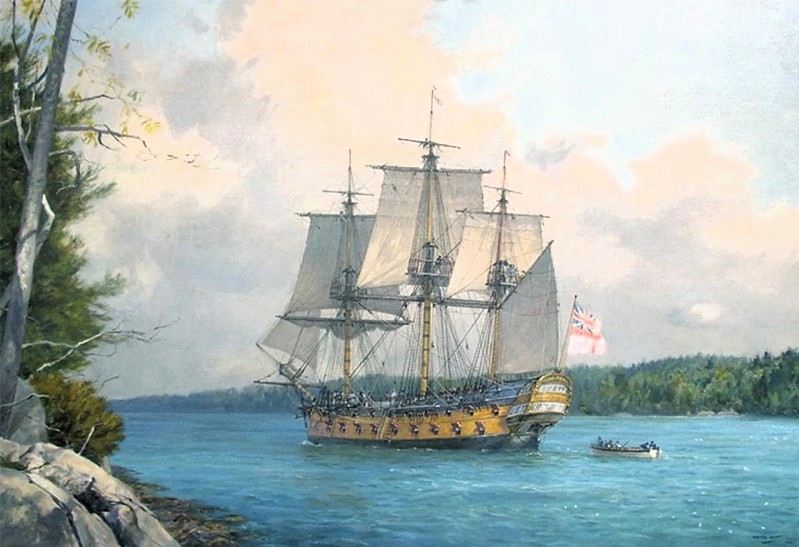
HMS Rainbow sets off on her 15-mile trek upriver into hostile territory during the American Revolution. It was a high-risk passage against both the elements and the odds, but her indefatigable captain deemed it “a military necessity.” Geoffrey Hunt, Trouble Heading for Wiscasset: H.M.S. Rainbow in the Sheepscot River, Maine, 10th September 1777 (Private Collection) US Naval Institute

A ship approached, her three topsails luffing in the confused wind. Only the small sails fore and aft billowed. Men scrambled on the yardarms, reefing the lower sails. The hunters knew European ships. White men had plied Wabanaki waters for more than a century. But this one was different. The men on the top decks wore red coats, and the pennant flying astern told the Wabanaki this was the British tribe. This ship was bigger and more heavily armed than any they had seen before. The Wabanaki counted twenty-two gunports on her starboard side, with the lower ports battened to thwart the churning chop. The men aboard looked hard and fierce, and the Wabanaki were lucky to be ashore and protected. The spirits were pleased.

The hunters watched the ship pass and wondered where she was going. Was she lost? She was too large for the passage, and there was no settlement or European encampment in her direction. The nearest British town was Wiscasset, five miles to the north on the main channel of the Sheepscot.

Aboard the HMS Rainbow, Sir George Collier, captain and acting commodore of the British Royal Navy forces in Halifax, came to the same conclusion. Night approached, and the storm began. Captain Collier was an aggressive, tested commander. But he was now responsible for a British ship of the line floundering in unknown water, amid rocky ledge, submerged hazards, sucking mudflats, and an unforgiving tidal flow. The local fisherman, impressed as a pilot in Boothbay Harbor, claimed to be a royalist. He claimed to know the route to Wiscasset, where the mast-ship Gruel was loading its nautical contraband for a trip to France. That was Captain Collier’s mission. Take or destroy the Gruel. Now he suspected his involuntary pilot to be an American militia sympathizer. His compass reading didn’t lie. They were sailing east, not north. He would not allow the Rainbow to founder. He called the order, “Cut the lashings on the ‘best bower’ to the starboard foremast channel. We will anchor here. Douse any sails reefed or still set.” Thus, the outsized Rainbow at 133 feet along her waterline, and drafting twenty feet, set anchor in the narrows of Oven’s Mouth.

Amid the endless Maine frontier in 1777, countless white pine trees towered to perfection. The British and the French marveled at their utility for nautical construction. Both nations had depleted their native forests of oak and other suitable timber. Maine’s prized specimens rose forty feet or more and measured forty inches in diameter at their flawless trunks. Turned by the hands of journeymen, these ‘sticks’ became masts, bowsprits, topmasts, yards, and spars at the Halifax Naval Yard or one of six Royal Navy Dockyards in England. They were perfect for masting the brutes of the sea, ships of the line, the vessels that decided battles, blockades, and the fates of nations.

Continental wars blocked British access to Baltic timber in the 1650s. And even with access, Baltic trees were seldom more than twenty-seven inches in diameter. So, King William III appointed a surveyor general for New England. The surveyor’s minions tramped the virgin forests and marked ramrod pines greater than twenty-four inches with three axe strikes in the symbol of a broad arrow. These were the king’s pines. This possessive insult enraged the American colonists. The British applied severe penalties for stealing these pines, skirmishes erupted, and a black market flourished. In 1772, colonists revolted in Weare, New Hampshire. Early in the morning, after an overnight rally in a local tavern, townspeople blackened their faces. They set upon a dozing sheriff and his deputy and whipped them senseless with switches. The rioters shaved the manes and tails of the lawmen’s horses. They even severed the poor beasts’ ears, then mounted the sheriff and deputy to ride out of Weare down a gauntlet of the aggrieved. Colonial resentment smoldered as the Pine Tree Riot predated the Boston Tea Party by a year and a half.

By 1777, with the colonies in full revolt and the French backing their rebellion, the British needed masts. These strategic components in the hands of the French would be doubly damaging. The intelligence possessing Captain Collier as he advanced up the treacherous Sheepscot was that a suspected mast shipment was making ready north of Wiscasset, bound for Cherbourg.

In the early hours of September 10, Captain Collier ordered the launch of two of the Rainbow’s cutters, the smaller boats for transporting the Royal Marines. He ordered a cutting-out raid on the Gruel, and a hundred marines and sailors set off from Oven’s Mouth under the cover of darkness and rain. Cutting out was the term for commandeering an enemy vessel, in this case, the Gruel. The two cutters snuck past the sleeping village of Wiscasset. Then the raiders rowed north on a flood tide where, according to the impressed fisherman now with the raiders, the Gruel was loading her contraband.

When dawn broke on the Rainbow, Captain Collier saw how close they had come to disaster. The ship could barely swing on her hawser without grounding. Collier launched the remaining cutter, and with deft seamanship, the cutter’s crew wrapped the ship out of its predicament and into the main channel of the Sheepscot. By early afternoon, the Rainbow anchored off Wiscasset Point, positioned to level the town with cannon fire.

Worried locals breathed easier when Captain Collier sent a party ashore under a flag of truce. Collier’s emissary delivered a letter to the local magistrate demanding the surrender of two small cannons and the contraband pines he believed to be loading nearby. Thus, negotiations began with the exchange of letters.

The two cutters arrived at the Gruel near sunrise. The Royal Marines surprised the Gruel’s master, boatswain, and two mates and took them prisoner without a shot or saber slash. After securing the mast-ship, they brought a three-pound cannon aboard and barricaded the boat’s deck with planks already aboard the Gruel. They were ready to return their prize. But they needed a favorable tide, a slack tide just beginning to ebb to clear the shallows and mudflats of the sinuous Sheepscot.

The Gruel’s cook, returning to the boat from shore, saw the capture and ran to tell the local militiamen’s quartermaster. By nine o’clock, the Lincoln County Regiment of Militia, 150 Sons of Liberty, lined the shore and began pelting the raiders with musket and cannon fire. Trapped by the ebbing tide, the raiders were powerless to wrap the Gruel into the river channel. The raiders hunkered down behind their plank armament. Around noon, a second cannon arrived and pulverized the improvised palisade aboard the Gruel. The raiders were in a tough spot.

Captain Collier grew concerned around sunset and launched the remaining cutter. However, the boat returned, fearing an ambush upriver. They were right.

The raiders were running out of options. The Gruel was too large to maneuver down the twisty river. The cutters would have to wrap her off her mooring and tow her to deep water. At ten o’clock, with the moon setting, a raiders’ detachment shoved some of the mast and spars into the river and holed the mast-ship. Then they snuck aboard their cutters in the Gruel’s lee and started downriver. But the Sons of Liberty were waiting. The raiders’ flight stalled when they encountered a boom pulled taunt across the river by the militiamen. The raiders were lucky to hack their way through the heavy rope and out of danger with only one man injured by militia fire. At eleven o’clock, the first cutter hove up along the Rainbow. Captain Collier recovered all the raiders, their prisoners, and both boats by midnight. But the wind was against them as the militia massed at Wiscasset Point.

Negotiations continued while the Rainbow waited for an ebbing flood tide and a favorable wind. Collier bluffed and told the Sons of Liberty they had one hour to evacuate Wiscasset before he opened fire to level the town. It bought him time. Finally, with favorable sailing conditions arriving in the early hours of September 12, Collier relented. He released the prisoners onto a small, commandeered schooner for a promise of safe passage as the Rainbow navigated the Sheepscot narrows.

The Rainbow’s raid on Wiscasset was a measured success. They recovered three main masts and one mizzenmast. The raiders decommissioned the mast-ship and denied the French important contraband. Rainbow suffered only one man wounded. Sir George Collier entered history books as a successful, daring naval officer. He won a major victory against the colonialists in the 1779 Battle of Penobscot Bay.

The fisherman, though, that’s who interests me. Therein lies the lore.

François Arsenault was the fisherman, but he told the British he was Samuel Jones. He was a linguistic chameleon and spoke the English of the colonists, his mother’s tongue. They never suspected he was French. The disdainful British looked down on the colonial dialect and lumped François into the heathen herd.

François was nineteen years old and unmarried. He towered over most other fishermen. His light beard framed his handsome features. He wore rough, sea-worn clothes, and his dark hair flowed from beneath his knit cap pulled low against the Gulf of Maine chill. He was three weeks engaged to Danielle from Monhegan Island.

François was smart. Born and raised on the coast of Maine on the island of Southport, he had learned much in his years fishing with his father. He knew the water, and the vessels that sailed it. But he had never seen a ship the size and menace of the HMS Rainbow. He squinted to make out the detachment of Royal Marines approaching in a cutter. The British were ruthless, and François feared impressment or punishment for disobeying their orders. He thought of Danielle on Monhegan’s Pebble Beach, propped on a worn wool blanket, watching seals cavort on the ledge near shore. Her soft auburn curls danced on her lithe shoulders when she laughed. He would do anything to be with her again.

Six sailors oared the cutter with a coxswain at the stern. It surprised François how fast the boat moved through the chop. Perfectly synced long oars propelled it like a water strider on a pond. Four grim, musket-toting marines stood in the bow of the eight-meter boat, their red coats fluttering in the building nor’easter. Bayonets dangled on their cross belts. François’s single-masted fishing skiff could neither outrun them nor defend against them. He had just set sail for Boothbay when the Rainbow appeared on the horizon.

The British would take no quarter with a Frenchman. So, when the older marine hailed him, he answered in English, “Yes, I fish the Sheepscot. I have fished as far north as the reversing falls above Wiscasset Point.”

The solemn marine declared, “In the name of His Majesty King William III, I order you to come with us. Secure your skiff here and come aboard.”

François hesitated, then waved at the approaching front and pleaded, “But, my lord, my boat may swamp in the coming gale. If I lose my boat, I cannot make a living.”

The pitiless soldier sneered, his words as cold as the murky depths, “If you do not do as I order, you will have no need to make a living.”

A fearful and overwhelmed François played out his anchor, obeyed the order, and began living a lie to save his life.

As a little girl growing up on the coast, she listened to the lore at family gatherings. These get-togethers of thirty or more boisterous relatives always made her smile and laugh. The men built a raging fire in a pit on the rocky shore. Then, in a flame-marred kettle, they boiled lobsters in a stew of salty Atlantic, seaweed, clams, cut potatoes, whole onions, corn on the cob, and hard-boiled eggs. They drank beer and coffee brandy and told stories from the dismal past. They told how François escaped from British servitude, and his subsequent move to Monhegan. Monhegan was French-controlled territory and had been since 1689. With the end of the French–Indian War in 1763, Monhegan became France paisible.

François was with the British when they took the Gruel. He withstood the Sons of Liberty’s bombardment. When the detachment from the Rainbow snuck from the Gruel back to their cutters under fire in the darkness, François parted company in the chaos. On the river’s bank, the militiamen identified him as a friend. Lucky for him. The quartermaster recognized François and vouched for him. Fearing the British might track him and hang him for desertion, François retrieved his skiff and sailed for Monhegan a day later. He and Danielle married on Christmas Eve 1777, and over the next thirty-nine years together, they raised eight healthy, intelligent children with love, hard work, and good fortune. Not a day passed that François did not thank God for allowing him to escape the British and marry Danielle.

Note: It’s well documented that a fisherman was forced into military service by the British in Boothbay Harbor, but what happened next is lost to history. The post-impressment life of François is fiction. In The Tide of Deception, François becomes the familial anchor for my seven-generations-later protagonist, Sandy. Sandy is a single mother of a precocious seventeen-year-old daughter and a senior researcher at Bigelow Laboratory. Sandy is preoccupied with a rogue tide that pounded Boothbay Harbor on October 28, 2008. Her obsession leads her into unforeseen circumstances. And yes, the Boothbay Harbor mystery tide is real.
September 4, 2025

Editorial Response to Washington Post: On WWII anniversary, China seeks to erase U.S. role in victory (September 2, 2025)
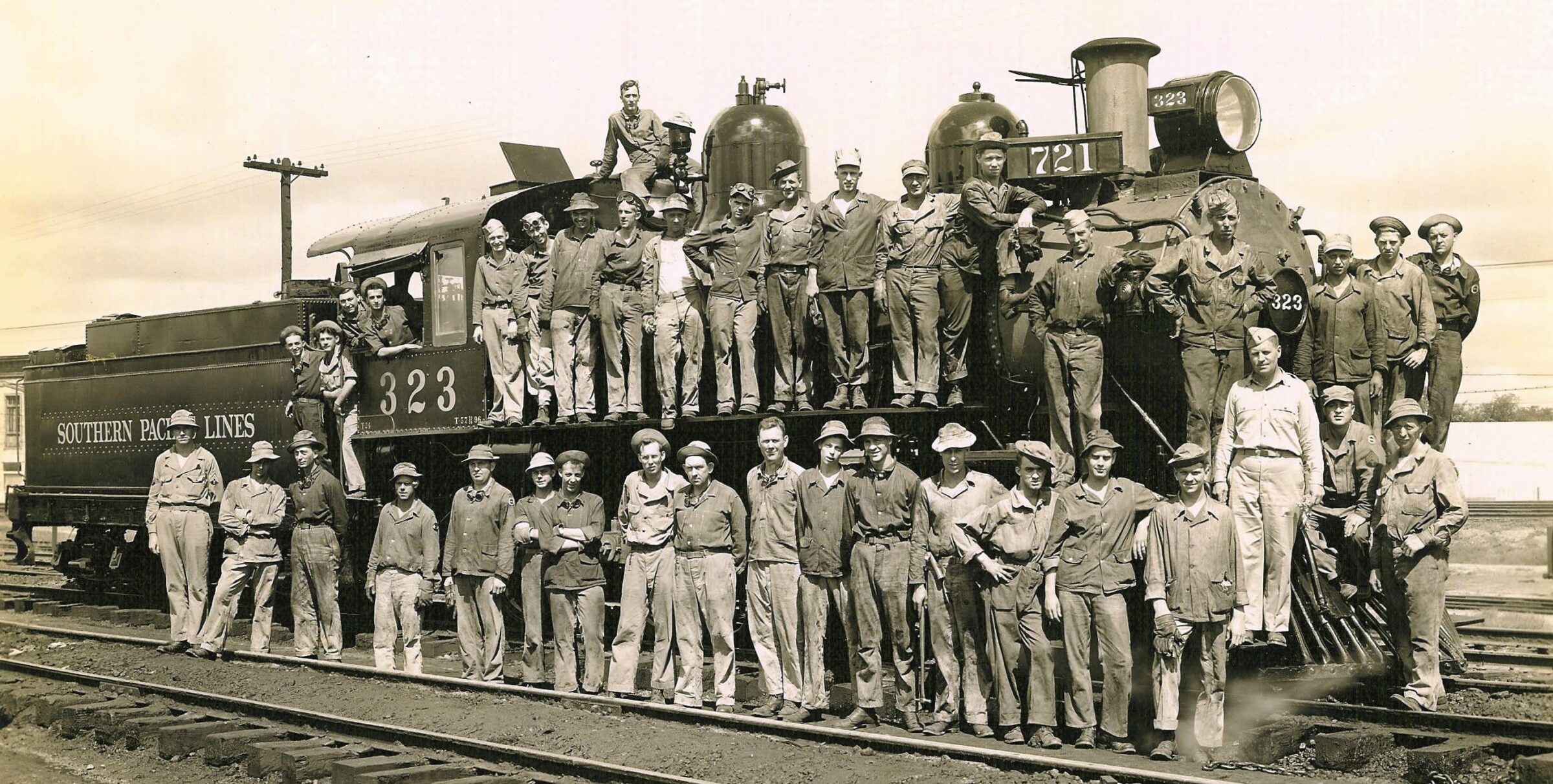
Americans played a crucial role in the World War II effort in the China-Burma-India (CBI) theater. China had no indigenous arms capability save clubs and stones. American railway operating battalions, like my father’s unit, the 721st, took charge of the rail link from Calcutta to Ledo, India, and ran freight to an eleven-mile-long depot. From there, U.S. Army Air Corps crews made the unforgiving flight over the Himalayas into China in overfilled C-46s and 47s. All told, 225,000 Americans served in CBI, and the American armed forces employed even more local civilians.

In 1943, U.S. Army construction units began building and operating the 1,100-mile-long Stilwell Road (also known as the Ledo Road) through the treacherous mountains of Japanese-occupied Burma to Kunming, China, to support Chiang Kai-shek and his warlords in the fight. These 15,000 U.S. Army construction units were African-American enlisted men with white officers, and they died from enemy attacks, disease, and accidents at the rate of a man a mile. When black truck drivers arrived in Kunming, China, in January 1945, Chiang ordered that they switch with white drivers, so as not to upset his racial sensitivities. General Stilwell intervened, pairing white and black drivers.
The Allies saw China as a land-based aircraft carrier from which to bomb the Japanese Home Islands until May of 1945, when the atomic bomb campaign took shape on Tinian. Strategically, the Allies needed China in the war on their side to tie down two million Japanese troops. This was never a foregone alliance with Chiang Kai-shek in charge.

China’s contribution to the war was significant, yes, and they lost untold millions to the Japanese. However, the Allies, particularly the Americans and British, bore the heavier burden and made Chinese resistance possible.

Steven James Hantzis, Author

Alexandria, VA

Rails of War: Supplying the Americans and Their Allies in China-Burma-India (University of Nebraska Press, 2017)
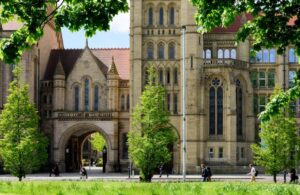
University of Manchester (UK)

I was delighted to hear from a professor of history at the University of Manchester in the United Kingdom last week. He wrote:

I read it for the first time about a year ago, and then taught with it last semester in my senior undergrad class on China’s international connections during the second world war. It fills a real gap in the scholarship and my students and I enjoyed both the human stories and the big picture of how CBI was tied together.

Rails of War is a timeless tale of working-class Americans being ordered to undertake a herculean task in a land not of their making and a culture unfamiliar and ageless. They accomplished and exceeded their mission under attack by a merciless enemy, indigenous saboteurs, as well as famine, monsoon, and disease. I’m pleased beyond words that Rails of War resonates today and that the travails of the brave men of the 721st Railway Operating Battalion lives on. Here’s to the University of Manchester. Well done.


The Tide of Deception readers were one step ahead of the public in understanding the recent 8.8-magnitude earthquake and resulting tsunami on Russia’s Kamchatka Peninsula. A close reading of the Washington Post on July 30 found a discussion of submarine landslides as depicted in Deception.


From the Post:

Why one of the world’s biggest earthquakes wasn’t followed by a monster tsunami

Why wave heights were relatively low farther from the quake “is the biggest question at the moment,” said Viacheslav Gusiakov, a tsunami expert in the Siberian branch of the Russian Academy of Sciences. As the wave spreads out, it weakens. But the similarly powerful 1952 earthquake in the same region caused bigger waves and more damage in Hawaii than Tuesday’s quake so far.

One possible explanation, Gusiakov said, is a potential absence of a large landslide in the ocean that could have exacerbated the tsunami. Underwater movements of sediments or rocks can add to the energy of a tsunami by up to 90 percent, although this specific case will need to be studied more.


Read The Tide of Deception for a taste of submarine landslides and their continent-changing power.
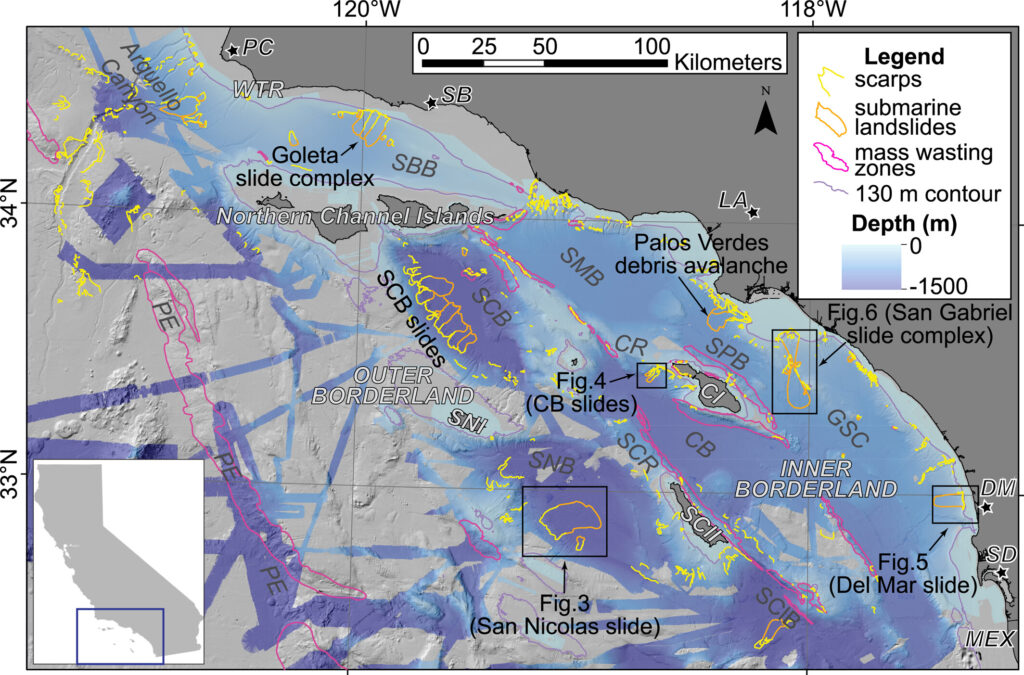
In new research, scientists from the United States Geological Survey (USGS) have identified nearly 1,500 submarine landslide features off the coast of southern California. These findings highlight significant geological risks to coastal infrastructure and populations, given the potential of submarine landslides to damage seabed cables, moorings, and even trigger tsunamis.
Staff Sergeant James Hantzis, shoved off from Wilmington, California on December 10, 1943, aboard the converted ocean liner, S.S. Mariposa. He and 5,000 GI Railroaders sailed west and south for 15,000 miles en route to India. Few had ever been to sea, let alone this sea.

      1 January 1944—S.S. Mariposa, Southwest of Tasmania

      The Skuas were grounded, hunger gnawing at them. Birds at the mercy of nature. Like all of God’s beasts, they cack-cack-cacked about the weather unable to do anything about it. They huddled in pairs and the pairs in colonies. Some tended their speckled eggs on the mossy cliffs in their nests of rocks and pebbles, and others stood close for companionship.

      Fierce winds blew for two days and even hearty, pesky, pilferers had to put off their raids. This was good news for unborn Adelie penguins still in their eggs, as it was for weak or lame penguins. It was by all counts a good thing for any beast, fish or mammal on the windswept shores of Antarctica clinging to the margins of life.

      Vulnerability is opportunity and the voracious Skua seized it, but only when they could fly. If they could fly, their razor-sharp beaks could find the flesh of the weak and convert prey to calories. If they convert the weak to calories, they can breed and fulfill the evolutionary imperative and fill their niche. Why else would any creature be in Antarctica?

      The sun would not set on the Skua today, the first day of the New Year 1944. It was austral summer and shoreline temperatures had reached a clement minus twenty-three degrees Fahrenheit. This was as far south as life went on the planet. Beyond these few hundred yards of glacial shoreline, life couldn’t make it. Conditions were harsh and simply too cold.

      Some would say the planet itself was alive and celebrating New Year’s Day with relish, roaring with exuberance. Count among those the men on the Mariposa.

      The cold of Antarctica is a wind machine. It cools the air above it. The cold air sinks because of its high density and the force of gravity. As the air sinks, it flows across the planet’s southern ice-dome and over the flat frozen plate of the continent, rushing northward unimpeded by topological obstruction. It rushes off the Antarctic shorelines sometimes with the force of a hurricane, a problem for Skuas and seafarers alike. The winds that leave the ice of Antarctica are katabatic or, in Greek katabatos, meaning descending. They are downdrafts that would make an angry Poseidon proud.

      Warmer air from the ocean mixes with the frigid katabatic air as it travels northward. This combination creates powerful low-pressure systems spawning polar cyclones that stalk the Southern Ocean, especially in January and February. Long ago, before anyone bothered to write it down, sailors named this part of the world, the ocean below Tasmania and Australia, the Roaring Forties. Forties for the south latitude and roaring for everything else.

      Aboard the Mariposa, the railbirds of the 721st also sought cover. Seas broke across her foredeck like water from a fire hose and the only safe place was below. Fierce westerly winds swept the sea before them and the sea was ready to sweep anyone or anything in its way.

      Below deck was packed. When the men tried to walk the corridors, it was like an amusement ride, only not amusing. The men who had developed sea legs coped and the men who hadn’t, endured.

      The Roaring Forties were the roughest patch of ocean the ship had yet encountered, and the safest place to be was below deck, hunkered. Below, with the men who had stopped using soap. Below, with the reek of disinfectant used to clean up seasickness. Below, with the overtaxed turbines trying to deliver the Mariposa to Bombay and safe harbor. The worst of it lasted five days and when the ship finally escaped into the calmer waters of the South Indian Ocean, everyone onboard breathed a little easier, figuratively and literally. The railbirds returned to their perches on deck, and the jokers in the crowd slowly became more humorous than irritating.

20 May 1945 0733 hours—378 Miles East of Yangkai, China

There is no instance of a country having benefited from prolonged warfare.

Sun Tzu—The Art of War (Circa 475 BCE)[1]

      The art of war was an airborne exhibition thanks to General Chennault’s Fourteenth Air Force. In the land of Sun Tzu, two and a half millennia after the noble warrior’s words, the art had changed. It was quite graphic. A product of GI creativity, the new art of war was less contemplative than Sun Tzu’s treatise, but unfailingly communicative.

      For instance, the nose art on Colonel Kinnard’s B-25D Mitchell Bomber. It told little about the war, the reasons for it or the tactics involved, but it told something about the warriors who flew her. Under the bomber’s cockpit window, a voluptuous reclining blond in red high heels wore a windblown blue blouse scantly covering her ample bosom. Her puckered lips teased the crew and anyone else looking on with the tagline, Show Me! Clever, since her commander hailed from Missouri. The double entendre was subtle and risqué. A real morale booster. Thus, the art told about the warrior, not much about the war.

      However, the small round shoulder patch that each airman aboard the bomber wore was more illustrative. It was a brown derby-crowned bulldog wearing a red and white striped sweater, diving headfirst from the clouds. Fifty-caliber machine guns flared from his nostrils, and he smoked a flaming cannon-cigar. Very Churchillian. This piece of art told you something. It told you about war in China. It was a graphic representation of the task at hand.

      The unit’s emblem told you that even though the 491st Bomb Squadron was just that, a bomb squadron, their B-25Ds bristled with strafing weapons. The 491st crew members often went on solo missions instead of flying in large groups and bombing set targets, like in Europe. This was the mission Show Me! had this morning. Sometimes, aircrews received intelligence on their bombing targets and a designated time for the bombs to be dropped. And sometimes, like today, they were told to take off, head in a certain direction and see what they could bomb, shoot or photograph.

      The B-25D Mitchell Bomber was a fine airplane, a real workhorse. She was built in a government plant in Kansas City, Kansas, leased to North American Aviation. Nearby, a converted General Motors Fisher Body plant manufactured the outer wings, fuselage side panels, control surfaces, and transparent enclosures.[2] About 4,000 Ds were built during the war, and they saw action in every theater.

      The D version carried a crew of six and seven machine guns. She could carry over five thousand pounds of bombs on her wings. She could fly just above the trees and cruise at 233 miles per hour. She was nimble for her size.

Building the North American B-25 Mitchell, Kansas City, Kansas

      Earlier that morning, the crew of Show Me! dropped her bombs on a target of opportunity, a fat Japanese convoy that had stopped to refuel. They were sitting ducks. Now, she was flying low over the green hills and wide rivers east of her base with crew members on the lookout for suitable targets.

      They overflew shot-up bridges and houses. Then, as they approached a wide river, the left waist gunner spotted three sampans. The pilot put the plane into a banked left turn and circled the targets. At five hundred yards, the waist gunner fired his twin M-2 Colt-Browning .50-caliber machine gun in short bursts, tat-tat-tat, followed by a couple seconds of silence. Then, tat-tat-tat. In less than one complete circle, the boats splintered and sunk. The largest of the three disintegrated when a secondary explosion of the gasoline drums it had been secreting erupted.

      Colonel Kinnard said through the intercom, “Scratch one Japanese oiler. Let’s see what else is on the menu,” and the plane continued eastward, just topping the hills.

      A few minutes later, they came upon a small compound of mud houses and the pilot told the nose gunner to fire on approach. The gunner walked the tracers and their dusty footprints through the empty courtyard and into the main building which disappeared in a brown cloud of churning dirt and straw. As the plane passed low overhead, the concussive blast of its twin 1,700 horsepower Wright Cyclones caved in the building’s mud-brick walls. A few soldiers came out of a small building and started shooting at the airplane as it passed by, three hundred yards beyond the target. The tail gunner returned fire, knocking down two and scattering the rest.

      Colonel Kinnard informed his crew, “We better go back. Looks like we left a few of ‘em kicking.”

      They circled the compound clockwise and the right waist gunner took his toll. Then, with the ground fire suppressed, and the buildings shot to hell, the plane climbed to deliver another item from its art of war catalogue.

      Colonel Kinnard keyed the intercom, “Left waist gunner, drop the leaflets and let’s go home.”

      The gunner opened the airplane’s escape hatch just ahead of the cylindrical Plexiglas blister housing the port side’s twin machine guns. Then, kneeling next to a stack of twenty bundles, each containing one hundred half-page sized leaflets, he grabbed two. As he threw out the first pair of bundles, a gust caught them and blew them back into the plane’s interior, creating a blizzard of paper. The slipstream was more cooperative with the remaining bundles and soon a graphic, psychological submission graced the countryside.

      The top half of each leaflet was a color depiction of an endless wave of approaching war planes trailing bomb sticks all the way to the earth. There were so many planes that they blocked the sun from the sky. At the bottom of the page, Japanese farmers, industrial workers, women, and children fled from burning factories, ports, and bridges. The Japanese characters on the lower half of the leaflet read:

      After dropping her load of leaflets, bombs and strafing fire, Show Me! Gracefully banked left and headed west towards home. She had once again done her part airing the art of war.

      Japan had two million men under arms on the mainland of Asia with the bulk of their forces in China.[4] In the spring of 1945, when they sought to defend the Home Islands and Korea, the troops they needed were on the great land mass to the west. Some say that it was China’s size that ultimately saved her from the Japanese. The American supplies were never enough, the Chinese nationalist fighting forces were subpar, and the communist movement focused on guerilla actions and political organization. No, Japan’s failure to conquer China was classic overreach. The Empire simply bit off more than it could chew. Sun Tzu’s formula for failure, a prolonged war, proved prescriptive.

      China started the Second World War as a basket case and ended it the same. The Sino-Japanese war was simply an interruption in a civil war that had started in 1911. Both sides in that war understood that they would fight again as soon as the Japanese left and planned their strategies accordingly.

      The Americans used China in a foreign policy relationship based first upon United States’ strategic interests and secondly upon support for democratic reform and economic development. The Americans hoped China would be a counterweight to the rise of Japanese dominance in Asia. The Americans didn’t need to “win the war in China,” although they planned to do so. All they needed was for China to stay in the war and bleed Japan of manpower and resources. This they accomplished.

      In 1941, on paper, China had 3.8 million men under arms, the largest army in the world.[5] Forty of her divisions, out of 316, were trained by German and Soviet advisors and mustered with outdated European weapons. The rest were irregular, undermanned and under-equipped. She was a paper tiger. Her soldiers were uneducated, untrained, and sickly. Whatever loyalty they had was to the local warlord that had impressed them into service rather than to Chiang Kai-shek or the nationalist cause. The officers’ corps was equally incompetent with mixed loyalties but, better fed.

      As the Japanese reluctantly pushed their campaign beyond Manchuria in 1937, the Soviet Union sent $250 million worth of tanks, trucks, and aircraft to Chiang. The British and French also pitched in. In December 1940, Roosevelt approved $25 million for China to buy one hundred P-40 fighters. Later that spring, he pledged $145 million additional lend-lease equipment. America pledged to outfit thirty infantry divisions and sent the retired air commander, Claire Chennault, to oversee the American Volunteers Group, the Flying Tigers.

      Thus began the American commitment to keep China in the war on the side of the Allies. With the loss of Burma and its overland route to China, the American supply effort took to the air. Flying the Hump, over the Himalayas, was a bold operation but it was always limited by the number of aircraft and staging areas. The supplies meant for China often lay piled and stacked in huge depots in Assam, awaiting aircraft and crews to deliver them. So, the Americans built the Ledo Road at the cost of a soldier a mile and focused their attention on northern Burma.

      When American lend-lease aid started coming through, Joe Stilwell became the commander in charge and began a tedious and contentious relationship with Chiang. Stilwell had Chaing’s number. The plain-speaking, no-nonsense Stilwell believed that air support was important, but that training and equipping Chinese divisions was the key to success. Working out of U.S. Army Headquarters in Assam, Stilwell kept two Chinese divisions under American command. Chiang, headquartered in Chungking, adopted as the wartime capital after Peking fell, was suspicious and insecure. He worried Stilwell’s divisions might someday constitute another armed movement, a fly in the ointment of his political ambitions.

      Chiang never liked the idea of Americans overseeing Chinese troops. So, when that was exactly what Roosevelt proposed in September 1944, that Stilwell take charge of all Chinese ground units, Chiang bucked and threatened to quit the war. Soon thereafter, Stilwell was out and General Wedemeyer was in and Roosevelt split the old CBI command into an India-Burma Theater and a China Theater.

      Wedemeyer had a better personal relationship with Chiang than Stilwell, but saw all the same problems. Meanwhile, the Japanese were on the move.

      The Doolittle Raid prompted the Japanese to attack Allied airfields in May 1942, even though none of Doolittle’s B-25s landed at Chinese airfields. The Japanese Army in China, the Chinese Expeditionary Force, pushed west, but their drive stalled before they could destroy the network of American airfields. A few months later, the Japanese began worrying about the potent B-29s in China because of their range and threat to the Home Islands. In April 1944, they launched Operation Ichigo.

      The Japanese promptly began pushing the Chinese out of their way. Chiang’s forces were completely ineffective and had it not been for American airpower attacking Japanese supply lines and troop concentrations, even more would have been lost.

      By the end of 1944, as things were looking up in Burma, the picture was far less promising in China. The Japanese were still advancing at will. Operation Ichigo had succeeded. The Japanese had captured Kweilin and then Liuchow, an important Fourteenth Air Force base. They had linked their northern and southern armies and secured a rail link to Indochina.

      In January 1945, Chinese defenses were weak. The Allies redeployed the old Stilwell divisions and moved the American Mars Taskforce from Burma to China to stiffen the resistance. This, of course, put the burden of winning Burma completely on the shoulders of General Slim and his British units.

      With the completion of the Ledo Road and subsequent reopening of the Burma Road in February 1945, the supply picture in China improved. About that time, General Wedemeyer began making limited progress organizing Alpha Force, thirty American-trained and equipped Chinese divisions.

      On April 8, 1945, Japan launched an offensive to capture the American base at Chihchiang, the Allied strongpoint guarding the approaches to Kunming. This was the supply center for all of China, and Chungking, the capital. Chiang’s army again melted in the heat of battle. But this time, riding to the rescue, the Americans hurriedly transported their new 6th and 94th Armies to Chihchiang. By June 7, they pushed the Japanese back to their original points of attack.[6] It was the last major Japanese offensive in China.

      On April 1, 1945, the Japanese Imperial General Headquarters promulgated Plan Ketsu, a reorganization of their entire ground deployment. The move would strengthen their defensive positions for the Home Islands and fend off an Allied landing in southern China. Ketsu ordered the return of thousands of soldiers to Japan and the concentration of China Expeditionary Forces along the coast.

      So, as the Japanese slowly pulled out of territory they had gained during Ichigo, the Chinese cautiously moved in to fill the void. Thus, the “Battle for China” was won, not so much by the Chinese but by the Americans and British who were making steady progress throughout the Pacific and Burma. The Japanese were also worried by the looming threat that the Soviets might soon join the fight.

      It was wise for the Japanese to worry. About this time, mid-May 1945, President Truman authorized Operation Downfall, the invasion of Japan. The first part of the plan, Operation Olympic, was set for November 1, 1945. Operation Coronet would follow in March 1946.

      Olympic would put an invasion force ashore on the southern-most Home Island of Kyushu, the same island that Kublai Khan tried to take in 1274. Four months later, Coronet would land another force on Honshu south of Tokyo. The casualties, as estimated by General Curtis Lemay, would be “well up into the imaginative brackets and then some.”[7] The United States Government, in prudent preparation, ordered the minting of half a million Purple Hearts.

-SJH Copyright 2023


[1] “Sunzi.” Encyclopædia Britannica. 2006. Encyclopædia Britannica Online. 4 Dec. 2006

http://www.britannica.com/eb/article-9070336. The passage is from Chapter II, Waging War, item 6.

[2] “North American B-25D Mitchell” North American B-25D Mitchell Retrieved June 16, 2008 Online: http://home.att.net/~jbaugher2/b25_7.html.

[3] “Aerial Propaganda Leaflet Database Second World War” Psywar.org Retrieved June 16, 2008 Online: http://www.psywar.org/apddetailsdb.php?detail=1945PAC151J1.

[4] Mark D. Sherry. China Offensive 5 May-2 September 1945 (U.S. Army Center of Military History, U.S. Government Printing Office, p. 1).

[5] Mark D. Sherry. China Defensive (U.S. Army Center of Military History, U.S. Government Printing Office, p. 5).

[6] Mark D. Sherry. China Offensive 5 May-2 September 1945 (U.S. Army Center of Military History, U.S. Government Printing Office, p. 24).

[7] D. M. Giangreco. Casualty Projections for The U.S. Invasions Of Japan, 1945-1946: Planning and Policy Implications (The Journal of Military History, 61, July 1997, p. 521-82). Also at http://home.kc.rr.com/casualties/.

Over 59,000 women served in the U.S. Army Nurse Corps during World War II. Thousands more, like Mary Louise Hantzis, R.N., my mother, cared for war-wounded in the States. Mary worked with a noted orthopedic surgeon in Indianapolis and saw war-torn bodies on every round. For Veterans Day 2021, I offer this vignette, an origin story of her profession.

U.S. Army Nurses, 10th Field Hospital, European Theater 1944 (National Archives)

December 1853—French Battleship Charlemagne—Constantinople Harbor, Turkey

Northwestern squalls bore the sulfuric tail of tanneries and south-westerlies reeked of abattoir coppery effluence. The weather blew in circles and from every direction, it stank of dead meat. Pelting rain was all that kept Pierre-Yves from nauseating embarrassment. The icy sting braced him, standing watch on the bridge deck. Morning skies were as gray as the waves and if the sun had risen, Pierre-Yves was not a witness. Thankfully, two charcoal caustic plumes from the ship’s stacks fell astern in her ten-knot advance. Charlemagne’s 368 feet of laden armored decking rocked and wallowed on a sea sent from the devil below. Pierre-Yves fought the list and heave to maintain his watch on the Russian shore batteries.

            Pierre-Yves wasn’t the only one who thought this deployment stupid. He wished he were home on his family’s farm near Artignosc sur Verdon tending to honeybees and olive trees. “Ah,” he thought, “It is the time of year for hunting the boars. This miserable trip was the work of fools. Ten minefields we have already sailed. Heaven is the weather in the south of France compared with the god-forsaken Bosporus.

            “Parle à mon cul, ma tête est malade!” he grunted under his breath in frustration. [Stop bothering me!]

            Other junior officers thought as he did, all faithful Catholics with the French prerogative of skepticism. A skepticism alive and well on this dubious expedition.

            Pierre-Yves was a bright, lucky boy from a privileged family. He worked hard at the Université de Paris-Sorbonne to earn his degree in Nautical Engineering. As a patriotic Frenchman, he enlisted in the service of his country upon graduation and held the rank of lieutenant in the French Navy.

            He spent late nights at the Sorbonne discussing philosophy, art, women, and religion. He was Catholic by birth and faith. But he could not fathom how a trivial matter, squabbling monks, justified sending an armada and thousands of men across the Mediterranean into hostile waters.

            “All for what?” he asked himself. “To stymie Russians for a Greek misdemeanor supported by the Tsar? C’est plus qu’un crime, c’est une faute!” [It is worse than a crime, it is a blunder!]

            “Over what?” he asked in silent monologue. “The keys to a church and a silver star?”

            He visualized a pair of Greek Orthodox monks in tall hats and long gray beards slinking into the Church of the Nativity in the middle of the night. He smirked. He shook his head and rain flung from the double bills of his Napoleon hat.

            In his visualization, now in full career, two fat buffoons kneeled on the marble, prying the fourteen-point silver star embedded in the ancient iron-stained grotto. He saw the Latin inscription, which he knew by heart, Hic de Virgine Maria Jesus Christus natus est. [Here Jesus Christ was born to the Virgin Mary.]

            He imagined the simpletons secreting the prize under their robes and scurrying back to their monastery like burglars, common thieves. The monks’ motivations were mysterious. Rescue of the sacred symbol from the Catholics? Whatever they were thinking, whatever their crime, it wasn’t worth killing for, or being killed for.

            “Hell, let the Greeks run the grotto. It doesn’t change the faith of those who believe and worship,” he muttered in exasperation.

            “À cause de rien,” he thought. [For no reason.] “Now, France must sail to the rescue and restore the luminary for the honor of church and country? This is folly. Men should never put religion above reason. Not in affairs of state. When both religions pray to the same God? Orthodox or Catholic, what’s the difference? The direction in which they sign the cross?”

            He raised the dripping brass telescope to his eye and scanned the Russian batteries. As he focused, a Latin phrase came to him from his late-night critiques at the Sorbonne, “Credo quia absurdum est.” [I believe it because it is absurd.]

Mary Louise Hantzis, R.N., 1944

Pierre-Yves was right. The Crimean War was absurd and deadly. Thieving monks were not the casus belli, although politicians presented it that way. The war arose from commerce and geography, with religion sprinkled atop for mass consumption.

            The big players were France, Britain, and Turkey against Russia. From late 1853 to early 1856, half a million men fought and died and twice as many civilians starved or died from disease. Conscripted soldiers abandoned family farms and industrial centers in Europe. On the continent, food grew scarce and famine’s fellow travelers, typhus, and malnutrition reaped thousands. At the front, France, Britain, and Turkey lost 70,000 killed in battle and 183,000 to disease. Russia lost 256,000 evenly split between battle and disease. But the dialectic that Pierre-Yves studied so intently at the Sorbonne held. Amid misery, carnage, and senseless bloodletting arose beauty, art, and human betterment.

            Because of the war, the United States purchased Alaska from Russia for a song. Russia, unhappy with the inferior quality of Alaskan furs, needed to keep the U.S. from entering the war on the side of her enemies. She offered our forty-ninth state for $7.2 million.

            And, in early November 1854, a lithe, thirty-four-year-old woman with a kind, determined face arrived at the British Barrack Hospital in Scutari, Turkey, today’s Üsküdar. There on the Asian shore of the Bosporus, she gazed at the Blue Mosque, St. Sophia, and Topkapi Palace in clear view from the peninsula of Stamboul. Opulence played hard against the grisly toil of endless caregiving, horror, and desperate improvisation.

Florence Nightingale, 1854

            With her traveled thirty-eight women recruited from the safe confines of Western Europe. She trained them in sanitation and statistics and how to care for the injured and sick. She established her triage haven with little support from the military and active resistance from male doctors and orderlies. Then, at the battle of Inkerman, the women’s angelic custody of casualties transformed the medical profession. At night, amid moans and the stench of bloody bandaging, Florence Nightingale walked the aisles of cots at Scutari. She held a lamp aloft to guide her way and reassure the wounded.

            Florence Nightingale invented and invested modern professional nursing. I, for one, am grateful. For had she not, my mother would have had to find other work, the same for my Aunt Pearl, Aunt Dorothy, and my niece, Kara.

A Lady with a lamp shall stand.

In the great history of the land,

A noble type of good,

Heroic Womanhood.

‘Santa Filomena’ by Henry Wadsworth Longfellow, 1857

­‑SJH

Memorial Day honors the sacrifice of veterans and all who served. But to a subset, Hoosiers, it’s also about the biggest sporting event on the planet. I count among them. Growing up in central Indiana, the Indianapolis 500 Mile Race was the soundtrack of our holiday weekend. My father, a China-Burma-India veteran, had the rare day off from being a machinist for General Motors. Dad relaxed with iced tea, watermelon, and my mother’s fried chicken once he finished whatever needed doing around our forty-acre farm. All the while, the radio broadcast the race and the versed, trustworthy voice of Tom Carnegie loosed the imagination.

Service in the nation’s defense and betterment might be a COVID-expanded view this Memorial Day. Allowed that latitude, I will blend two themes. My daughter’s service as a teacher at Park Hill High School in Kansas City, Missouri. And the 500 Mile Race.

Sara, like all American teachers, took on a perilous, stressful, and often thankless task this past year. And if you doubt that, read something else. With fingers crossed, it looks like Sara and her students will see better days ahead with the coming school year. Fingers crossed. For Memorial Day additional honors in 2021, I nominate Sara’s service and all teachers. Teachers, first responders, health care providers, those who care for the aged, grocery workers, delivery drivers, warehouse workers, meat packers, and farmworkers, all. Let them ride alongside veterans in this weekend’s fanciful parade.

 I tried hard to make Sara a motorhead. And it worked. So, I know she’ll be listening to the soundtrack of Memorial Day weekend as she relaxes into a recuperative summer. Then, come fall, she will rejoin the front lines and battle again in America’s indispensable engagement. Here’s to you Sara, and all those who led America through the darkness.

America can achieve improbable things. That’s our history. I hope this vignette reinforces that hopefulness.

BOGEY’S ELEVEN O’CLOCK HIGH by Robert Taylor

It is early in the Pacific War, 1943. The Marines have taken Guadalcanal and the Americans now have an airbase to use against the Japanese. On this night and the following day, that advantage bedeviled America’s public enemy number one.

To accomplish the impossible, everybody played their part, mechanics, pilots, commanders, and intelligence officers. Working as a team, they put America precisely where it wanted to be at the precise moment to succeed. Everyone working together.

Let us remember our veterans. They, better than most, understand the value of unity.

18 April 1943 0145 hours—Henderson Airfield, Guadalcanal, Solomon Islands

      Sparks from the welding torch peppered the long-cuffed glove of Marvin’s right hand. Its stiff and tattered leather covered greasy fingernails, a callous palm, and raw, bloody knuckles. The black glass on his gray hood revealed none of the intensity in the eyes reflecting only the fireworks showering from the underside of the P-38 Lightning’s wing.

      Master Sergeant Devers was accustomed to rush jobs. Last-minute modifications, seat-of-your-pants reckoning, and shade tree engineering were all par for the course. He proudly called his finished creations Kentucky Custom, even though he hailed from Ladoga, Indiana. The ground crews stationed on Henderson Airfield, codenamed Cactus, and home of the 339th Fighter Squadron, could improvise with the best. But tonight’s project was a mother.

      The big drop tanks had arrived late the previous afternoon, flown in by four B-24 Liberators from the 90th Bomb Group at Port Moresby, New Guinea.[1] Now Marvin and his men had the job of fitting 310-gallon external fuel pods to eighteen aircraft designed for 165-gallon tanks. They had to do it quickly. The squadron had to be in the air, in formation, and leave Henderson, at exactly 0715 hours.

      “We’re lucky,” thought Marvin. “Washin’ Machine Charlie must have a date. I hope she keeps him busy all night.” The thrashing sound of the Japanese aircraft’s unsynchronized propellers was the unwelcome prelude to bombs falling and nearby explosions. It was a distraction that no one needed that night.

      Marvin stepped out from under the wing and away from the intense floodlights. He moved to the front of the central nacelle, flipped up his welder’s hood and lit a cigarette. He leaned on Miss Virginia’s nosecone under the barrels of her four 50-calibre Browning machine guns and right above her 20mm Hispano AN-M2C cannon. In the light rain he scanned the rutted, packed-coral airfield and half a dozen other work bays.[2]

      Sparks were flying, floodlights were blazing and men in dirty coveralls moved purposely under giant tarpaulins in the revetments. Through the patter of the rain and the hiss of welding torches he heard strains of Glen Miller’s Serenade in Blue lilting from a pilot’s tent.

      He thought to himself, “Whatever this mission is, it’s a big one. The brass has been on the move for the better part of three days.”

      Then he thought, “Break’s over. I better get busy installing that big-ass ship’s compass in the Major’s cockpit.”

      Marvin had often heard the pilots complain about the fluxgate and magnetic compasses in the P-38s. The pilots told him that the only time they knew their exact direction was when they were lining up for takeoff. Only then could the instruments be swung into proper alignment.

      Marvin thought, “Wherever these guys are headed, it must be hard to find. Mitchell doesn’t want to take any chances, either way… Mitchell’s the CO and the Old Man gets what he wants.”

      Marvin was curious about where the squadron was headed. He’d heard the rumors about the mission and thought, “That son-of-a-bitch must be out there thinking he’s out of range. That would be the only reason for the big drop tanks.”

      He poured a cup of coffee from a dented metal thermos, took a sip, grimaced, and tossed the rest to the ground. He did a little math in his head. “The normal fuel consumption of the twin Allison V-1710, supercharged, liquid-cooled engines at 2,300 RPM maximum cruise power is 113 gallons per hour. Two gallons a minute.[3]

      “The Lightning has a 410-gallon internal fuel capacity, and his crews were outfitting each of the birds with a 310-gallon drop tank and a 165-gallon tank. The squadron would leave base with 885 gallons onboard. He divided 885 by 120 and estimated that the birds could be in the air for seven hours, if they didn’t see combat.”

      A Lightning in combat sucked gasoline like a tornado so he cut his estimate in half.

      The Lightning had a top speed of a little better than 400 miles per hour, but usually cruised around 260. “So,” thought Marvin, “If the birds could be aloft for four hours it meant they could cover roughly 1,000 miles.”

      He assumed they’d return to Henderson. Marvin couldn’t think of another friendly airfield in the God-forsaken Pacific. He thought, “Whoever or whatever they are targeting could be 500 miles away. Wherever they are headed, it is deep into Japanese territory… on Palm Sunday.”

      The rest of the night went by quickly. A little before 0700 hours, Marvin swung Mitchell’s compass for the third time. Then he climbed down from the cockpit to join the rest of his ground crewmen who were watching the P-38s make ready for takeoff. Blue smoke belched from exhaust ports as all thirty-six engines snarled to life.

      “So far so good,” thought Marvin.

      The din of eighteen planes ready for launch perked up his weary mind and body. The acoustic signature of a P-38 was unmistakable. The twin V-12s of a solo P-38 made a quiet whuffle sound because superchargers muffled their exhausts. But all the planes idling together created a sonic pulse and a thunderous rhythm all their own. The sound sent a wave of power and pride coursing through the ground crews.

      At 0710 hours, CO Mitchell revved Miss Virginia’s powerful V-12s to full RPMs and planted his feet on the aircraft’s brakes. He checked the ship’s compass heading for the last time to make sure it lined up with the runway, released his brakes and was airborne seconds later. Once in the air he circled Henderson at 2,000 feet awaiting the others.

      Seventeen planes made it into the air. One busted a tire when the over laden bird struck a jagged piece of metal planking as it trundled down the runway. A few minutes after the formation departed, another had to turn back to Henderson because of a drop tank, fuel-feed malfunction. By then, Marvin was in the mess tent having his breakfast of Spam, dried eggs, and more coffee.

      Major John W. Mitchell now had sixteen birds to complete Operation Vengeance. He was told it was a mission to which, “The President attaches extreme importance.” His plan of attack had to be adjusted.

      The two missing planes were shooters from the four-plane Killer Section of the squadron. Maintaining absolute radio silence, CO Mitchell hand-signaled for Lieutenants Hine and Holmes to move up in formation and join Captain Lanphier and Lieutenant Barber as attackers. That left twelve fighters for the Cover Section.

      Mitchell had set up other visual signals to command the squadron in flight. When he wanted the formation to tighten, he wagged his wings and when he want them to spread out, he kicked his rudders to make Miss Virginia fishtail.[4]

      By 0725 hours, the squadron was in the air and Mitchell led them on a slow descent to the water. They flew just above the waves on a northwesterly course that kept them at least fifty miles away from the Japanese-held islands of New Georgia, Vella Lavella, and the Treasuries. Mitchell watched helplessly as a P-38 less than one hundred feet in front dipped into the froth of a wave tip and splattered saltwater on Mitchell’s windshield. With the smooth green ocean just thirty feet below and the blue sky as a horizon, depth perception was dreadful. But skimming the waves was the only way to avoid Japanese radar and lookouts.

      The P-38 Lightning was designed for high altitude service where the air is cold. The plane had no cooler for the cockpit, and the sun beat down on the pilots in their low-flying greenhouses. Every pilot knew that you couldn’t open the canopy of a P-38 in flight without generating severe buffeting. And buffeting was the last thing anybody wanted flying thirty feet above the ocean. Especially since not every pilot had an inflatable rubber dinghy onboard. These survival rafts were in short supply, so the pilots cut cards to see who would carry one. The theory went that if a man ditched without a raft, someone with a raft would circle and throw his dinghy from the cockpit.[5]

      The men sweated, counted sharks, manta rays or driftwood and some, including Mitchell, grew dangerously drowsy. The CO had been up most of the night studying maps and plotting navigation. He had managed a couple hours shut eye and was back up at 0430 hours rechecking his calculations.

      By 0800 hours, Mitchell’s squadron was 285 miles from the planned interception. Precisely fifteen minutes earlier, exactly on time just as their commander insisted, two Japanese G4M Mitsubishi Betty bombers, took to the air from Lakunai Field, Rabaul. They were escorted by six Zero fighters. Flying conditions were perfect, and all expected a precise 0945 hours touchdown at Buin on Ballale Island, 315 miles away, just as Magic said they would.

      Magic was the codename for the American cryptography team tasked with breaking the Japanese JN25 code. An American radio post in the Aleutians had intercepted a high-level Japanese transmission four days earlier, and its decryption started the chain of events that launched the 339th Fighter Squadron.

      Mitchell’s job was to find and surprise the Japanese formation. He had planned well and carefully thought through the navigation and attack. But the odds seemed long indeed. He figured their chance for success was one in a thousand.

      Twenty minutes after the Japanese left Rabaul, Mitchell changed course for the first time. He carefully watched his airspeed, compass and time and swung the squadron slightly to the north. They were abreast of Vella Lavella a half hour later when they made their second planned course change shifting ever more slightly again to the north. Mitchell made their final planned correction at 0900 hours and headed northeast toward the coast of Bougainville, forty miles away. He directed the squadron to begin a slow climb and test fire their guns.

      Minutes later, Old Eagle Eyes, Lieutenant Canning, broke radio silence with a cool, “Bogeys! Eleven o’clock high.” Against the eight-thousand-foot-high Crown Prince Mountain Range on the southern coast of Bougainville specks in the sky became a formation.

      Mitchell couldn’t believe his eyes, but there they were. The Betties were in the lead at about 4,500 feet. The Zeros formed a V in two sections of three 1,500 feet above the bombers and slightly to the rear. Every plane was brightly painted and looked brand new. They were right on schedule, 0935 hours, exactly where Magic said they would be.

      The P-38s jettisoned their drop tanks and Mitchell’s section hauled back on their yokes and slammed their throttles to the firewalls as they climbed for altitude to cover the attackers. The four killers went straight at the two Betty bombers, but Lieutenant Holmes could not drop his tanks. He tried to jar them free and peeled off down the coastline, violently juking his P-38, hoping to shake them loose. Lieutenant Hine, his wingman, followed for protection but could barely keep up with all of Holmes didos or trick maneuvers. That left Lanphier and Barber to close on the bombers.

      The Betties were slightly above them at one or two o’clock. Lanphier and Barber angled for a right-turning, pursuit-curve attack. The Zeros spotted the two Lightnings while the Betties were still a mile ahead and two miles to the right. The Japanese fighters dropped their belly tanks and dove on the P-38s.

      The lead Betty nosed down into a diving turn to escape. With the Zeros on them, Lanphier banked slightly left to meet them head on. He cut loose a burst of machine gun fire and blew the middle Zero from the air, scattering the other two. This freed Barber to go for the bombers.

      Barber turned right and saw one Betty going hell bent for leather in a downward 360-degree spiraling turn headed for the jungle. Barber fired the P-38’s non-converging weapons across the top of the fuselage at the right engine. At the same time Barber slid over to get directly behind the target and his fire passed through the Betty’s tail. He saw pieces of the rudder separate from the plane.

      Barber kept firing. His 20mm cannon shook the P-38 with its dull POM-POM-POM report. With the Betty just one hundred feet in front of him, it suddenly snapped to the left and slowed rapidly. Barber screamed by the doomed craft at 425 miles per hour and saw smoke pouring from the right engine.

      In the next instant, three Zeros began firing on Barber’s tail. He shoved the yoke forward and headed for the coastline on the deck at minimum altitude, as fast as the P-38 could fly. And thankfully, that was faster than the Zeros.

      Holmes had finally shaken the faulty drop tank and returned with Hine to chase the Japanese fighters off Barber’s tail. As Barber looked back to check for pursuers, he saw a column of black, oily smoke rise from the jungle.

      Lanphier, after downing the Zero and scattering the formation, found himself at about 6,000 feet. Below, he spotted the wounded Betty flying across the jungle canopy and began firing a long, steady burst at right angles across its path. He felt he was too far away for a hit and was surprised to see the Betty’s right engine and right wing burst into flame.

      Holmes spotted the second Betty diving towards the sea and gave pursuit with Hine on his wing. They were delivering heavy fire from behind when Barber joined the attack and sent the bomber cartwheeling into the sea. Barber closed so fast on the Betty that his yoke vibrated fiercely as he reached the compressibility limit of the aircraft. Had he dived faster; the tails would have come off. His momentum carried him through the exploding debris.

      With the two Betties down, the mission was accomplished and the P-38’s broke off to return the 410 miles to Henderson as best they could. All made it back save for Lieutenant Hine, who was listed as missing in action.[6]

      Lanphier’s Lightning came home with two 7.7mm rounds through his rudder. Barber’s fighter limped home with a busted intercooler, a dented gondola, paint damage everywhere, and one hundred and four bullet holes. When he heard the first plane land, Sergeant Devers poured coffee into his thermos from the mess tent percolator, and he and his ground crews went to work immediately.

      Fleet Admiral William F. Bull Halsey was notified of the mission’s success when Henderson transmitted the code phrase “Pop goes the weasel.” The last sentence in that brief dispatch was a reference to Doolittle’s raid on Tokyo which had taken place one year earlier. It read, “April 18 seems to be our day.”

      The Admiral signaled back, “Congratulations to you and Major Mitchell and his hunters. Sounds as though one of the ducks in their bag was a peacock.” The Admiral showed his gratitude by sending the squadron two cases of combat whiskey, a commodity previously impossible to come by through official channels.

      Near Buin, Lieutenant Hamasuna’s Japanese road construction gang received radio orders to form a search party. They found the bomber’s wreckage in the jungle near Moila Point a mile from the Panguna-Buin Road late the following day. It was tail number 323, Yamamoto’s airplane.

      The wings and propellers had survived, but the fuselage had broken just ahead of the Rising Sun insignia. The section forward from there to the cockpit was burned out. No one had survived the crash.

      Admiral Yamamoto’s body was found outside the fuselage in a cabin seat with his safety harness fastened. His head was drooped forward as if in deep thought. He had been shot through the skull by a machine gun bullet. He wore white gloves, ribbons and medals, and his left hand grasped the hilt of his sword with his right resting lightly upon it. The Sword of the Emperor, ever swift. In his pockets were a diary and copies of poems.

      Yamamoto’s body was brought back to Buin by Corvette. There it was autopsied and cremated on a mountain in a military ceremony.[7] His ashes were placed in a square white wooden box lined with papaya leaves. Two papaya trees were planted at the site of his cremation.[8] His ashes were returned to Japan where his death was announced a month later.

      On June 5, Yamamoto’s ashes were placed in a small coffin over which was draped a white cloth. The coffin was carried through Tokyo on a black artillery caisson and the procession was led by a military band playing Chopin’s Funeral March.[9]

      Three million mourners came to his state funeral in Tokyo. The coffin wound its way to Tama Cemetery where his urn was placed in a grave next to Yamamoto’s mentor, Admiral Tojo.

      A second, private ceremony was held in Nagaoka, his hometown. There, half of his ashes were buried next to his adopted father on the grounds of a Zen temple. A stone marked the grave with the simple inscription: Killed in action in the South Pacific, April 1943.

      The news came as a shock in Japan. Yamamoto was the most popular military leader, second only to the Emperor. He was only the second commoner to be granted a state funeral.

      Yamamoto was the driving force behind the Japanese war effort. He was more an icon than a man. But instead of boosting the morale of his troops after their defeat at Midway and the loss of Guadalcanal, as was his intent, his trip demoralized millions.

      Americans were elated. Yamamoto’s name was synonymous with the attack on Pearl Harbor and they saw his death as payback. The news of Yamamoto’s death was held by the American military until the Japanese made their announcement. The Americans did this hoping to conceal the fact that the Japanese code had been compromised.

      The Americans played their hand well. Even considering the surprise attack and the deadly efficiency of the American squadron, the Japanese refused to believe that anyone could break their code. They continued to pay the price of hubris.

      In Yamamoto’s safe aboard the warship Musahi, navy officers found an epic poem in the Admiral’s hand. In Japanese, the form precisely alternated five and seven syllables per line. Linguists have paraphrased it thus:

            Since the war began, tens of thousands of officers and men of matchless loyalty and courage have done battle at the risk of their lives, and have died to become guardian gods of our land.

            Ah, how can I ever enter the imperial presence again? With what words can I possibly report to the parents and brothers of my dead comrades?

            The body is frail, yet with a firm mind with unshakable resolve I will drive deep into the enemy’s positions and let him see the blood of a Japanese man.

            Wait but a while, young men! – one last battle, fought gallantly to the death, and I will be joining you.[10]

– SJH Copyright © 2020 Steven James Hantzis

Endnotes


[1] Shelby L. Stanton. World War II Order of Battle (New York, NY: Galahad Books, 1984, p. 39).

[2] “Lockheed P-38 Lightning – USA” The Aviation History Online Museum Retrieved June 15, 2007 Online: http://www.aviation-history.com/lockheed/p38.html.

[3] “The Jeff Ethell P-38 Crash” AVweb Retrieved June 15, 2007 Online: http://www.avweb.com/news/safety/183014-1.html.

[4] Shelby L. Stanton. World War II Order of Battle (New York, NY: Galahad Books, 1984, p. 57).

[5] Shelby L. Stanton. World War II Order of Battle (New York, NY: Galahad Books, 1984, p. 28).

[6] “Rex Barber – Hero of the Yamamoto Mission – Heads West” 18th Fighter Wing Association Retrieved June 15, 2007 Online: http://www.18thfwa.org/statusReports/srpt25/page1.html.

        The account of this highly disputed dogfight was largely taken from a source that supports Barber’s claim to have shot down Yamamoto. (18th Fighter Wing Association, Status Report No. 25, October 2001.) Lanphier also claims to have downed the Admiral’s airplane. The U.S. Army awarded a split-killer to each of the fighter pilots. The after-mission debriefing was delayed and horribly executed. The facts were never well-spelled out. In 1997, the American Fighter Aces Association gave Barber 100 percent credit for the shoot down of the bomber carrying Yamamoto. In 1998, the Confederate Air Force recognized that Barber alone and unassisted brought down Yamamoto’s aircraft and inducted him into the American Combat Airman Hall of Fame.

        For further background see:

        Rebecca Grant. “Magic and Lightening” Air Force Magazine March 2006 Retrieved June 15, 2007 Online: www.syma.org.

[7] Shelby L. Stanton. World War II Order of Battle (New York, NY: Galahad Books, 1984, p. 106).

[8] Shelby L. Stanton. World War II Order of Battle (New York, NY: Galahad Books, 1984, p. 106).

[9] Shelby L. Stanton. World War II Order of Battle (New York, NY: Galahad Books, 1984, p. 110).

[10] Shelby L. Stanton. World War II Order of Battle (New York, NY: Galahad Books, 1984, p. 109).

https://www.youtube.com/watch?v=iJk4tcwudVw#action=share

From Where They Came

This Memorial Day allow me to introduce a few of the men who led by example and molded America’s modern Special Operations Force. They were British, part of a secret organization called the Special Operations Executive (SOE). During World War II, SOE commandos fought in every theater and found time to come to America and train groups within the Office of Strategic Services (OSS), the forerunner of the CIA. OSS commando units were called Operational Groups or OGs. The men in OGs were highly vetted, physically honed, and fluent in at least one foreign language. They weren’t spies; they fought behind enemy lines in American uniforms. Typically recruited from the U.S. Army and Marines, they were Norwegians, French, Italians, Austrians, Germans, Dutch, Hungarians, Spaniards, Poles, Czechs-Slovaks, Yugoslavs, Chinese, Korean, and Thai. And they were Greeks.

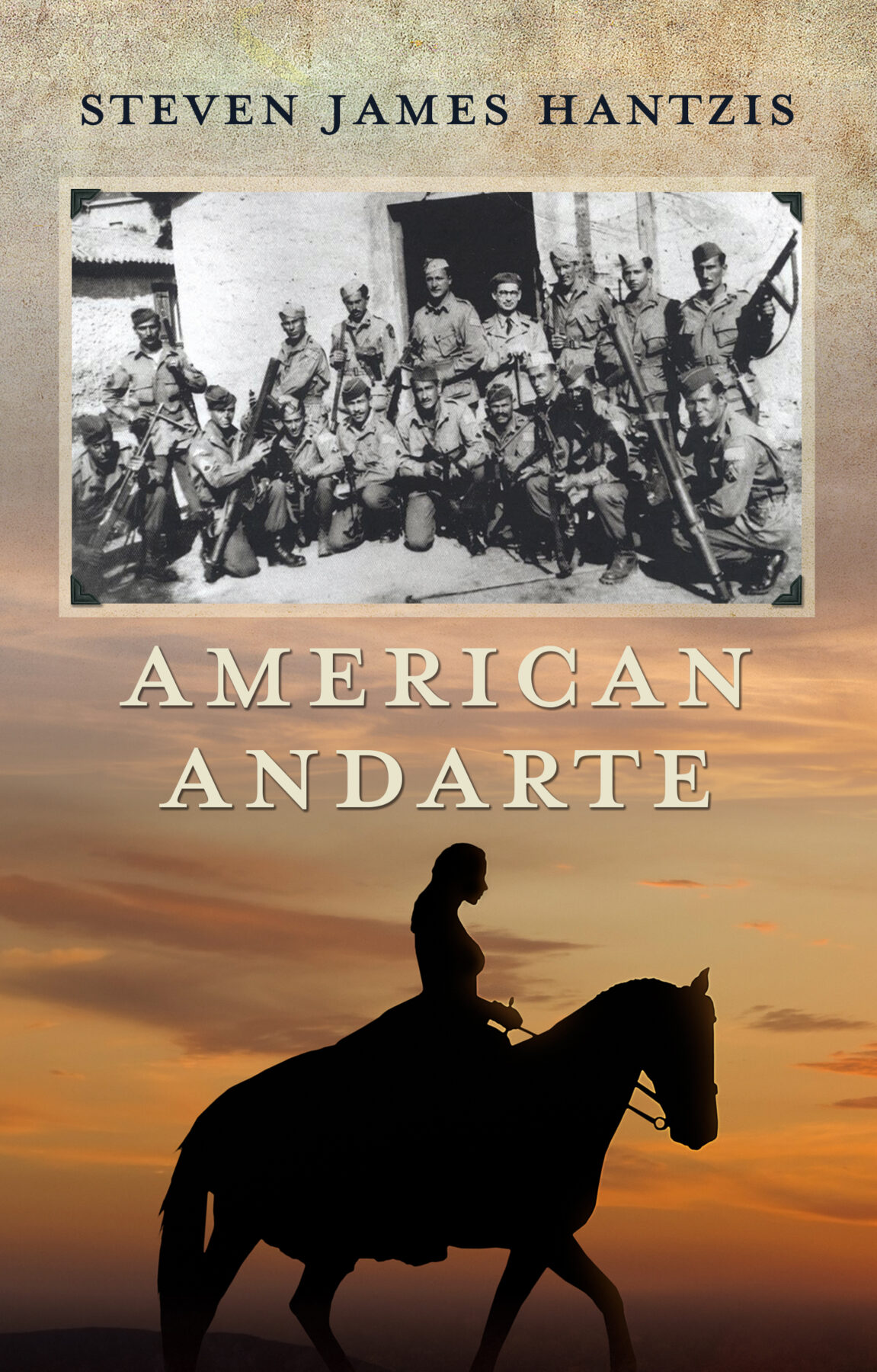
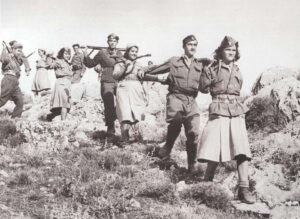
The manuscript I’m working on is American Andarte. Andarte is Greek for resistance fighter or guerilla. Greece was full of them during the Italian, Bulgarian, and German occupation of World War II. Most andartes belonged to either EDES or EAM-ELAS, rival resistance organizations within Greece. EAM-ELAS was larger and incorporated Greek communists, other progressives, and anti-monarchists. EDES was conservative and supported the king and accommodated the Germans. Believe me, Greek politics during World War II was complex. The book will supply details.

American OSS commandos in Greece, 1944

This vignette picks up in September 1942 with the first British SOE mission to Greece. The American OSS OGs would arrive a year and a half later in April 1944. Theirs is a fascinating story, classified until 1987. Until then, the CIA prohibited these American combat veterans from talking about their service. One hundred and eighty-one American OSS commandos served in Greece.

This is a section from a chapter in my manuscript so context might be foggy. The focus is on the British SOE and their first contact in Greece. The viaduct in this vignette is the Gorgopotamos Railroad Bridge. The sabotage of this crucial transportation link with the help of Greek andartes was their first SOE action. (There’s a great video about the mission featuring Monty Woodhouse.)

A few months later, the SOE struck again, this time alone. They brought down the highest railroad bridge in the country, the Asopos Viaduct, in an action believed impossible. Asopos is an entirely unique story covered in the manuscript and not for this post. It is enough to say that when the spans of Asopos Viaduct fell into the rushing river 330 feet below; the SOE made their mark on the history of warfare. The United States Army Special Operations Command today says that the attack on the Asopos Viaduct “was probably the single most spectacular exploit of its kind in World War II.” The Germans were so certain that the destruction of the Asopos Viaduct could only be an act of treachery that they shot the entire garrison guarding it that night.

Cairo, Egypt—September 1942

For all the complexity and drama that was Greek resistance politics, the Greek railway network was easy to understand. There was one standard-gauge mainline. It ran from the Port of Piraeus through Athens to Salonika in Greece, and from there to Sofia, Bulgaria, then Nis and Belgrade and Zagreb in Yugoslavia. At Zagreb, lines fanned out to Austria, Italy, and Hungary. The rail line carried forty-eight trains a day and completed an essential military line of communication. It stretched from the industrial centers of Germany through Piraeus to the Libyan ports of Tobruk and Benghazi. The Greek railroad was the only supply route with the ability to carry the weight of war. Over it rolled troops and supplies for occupation of the Balkans and the resupply of Rommel’s North Afrika Korps. It was a strategic target, of which the British took immediate notice. In the fall of 1942, they handed the problem to the Special Operations Executive (SOE), informally known as “The Baker Street Irregulars” or “Churchill’s Secret Army.”

On September 30, 1942, under a waning gibbous moon offering a bit too much light for the stealth intended, Lt. Colonel Eddie Myers, made a last check of men and supplies. Myers was a scrappy, assertive, thirty-six-year-old sapper from Kensington by way of the Middle East. The commander of the British SOE team climbed into an American-crewed B-24 Liberator on the tarmac of Deversoir Aerodrome. Deversoir was on the northern shore of Great Bitter Lake at the entrance of the Suez Canal.

Myers and three other SOE commandos boarded the first plane, and two more groups of four boarded two other planes. Each man, dressed in a British military uniform, carried an Enfield No. 2 Mk I .38 caliber revolver and a Fairbairn-Sykes commando dagger. They packed field dressings, and a Baker Street Kit comprising a compass that looked like a button, a map disguised as a silk scarf, a leather belt secreting two gold sovereigns, rations, torches, and poison pills for use if captured. They were parachuting into Greece. Their Sten submachine guns, grenades, and the detonators for their plastic explosives dropped separately in metal pod canisters.

They had done this before, two nights before. After flying four hours, eight hundred miles, over the Mediterranean into the mountains of Roumeli, Central Greece, they had turned away for Cairo. They had failed to spot the expected signal fires positioned to look like a cross. Tonight, was better. The pilot keyed the intercom and told Myers he thought he saw three fires burning in a valley below.

The snow on Mount Giona reflected the light of the moon and cast the palest glow on an alien world. The ancient name for Mount Giona is Aselinon Oros or moonless mountain. But tonight, the name misled. The Liberator descended to just above the peaks as Myers opened the bottom hatch in the airplane’s bay and jumped into the frigid darkness of the barely luminous unknown.

He fought updrafts from the mountain peaks. Buoyed and buffeted he blew away from his intended valley and drifted toward a forest of fir trees. He fought his heavy pack but couldn’t correct his descent. He landed high in a tall fir and crashed through its branches, ending on the ground with his parachute tangled above. His pack ripped from him in the fall, snagged on a stout limb and swung above. When he hit the ground, he sat for a few minutes in the snow and fir needles gathering his wits. The throbbing pulse of twelve, 14-cylinder Pratt & Whitney engines faded into the void. The Liberators were going home. It became silent, and Myers was alone.

There was no sign of the equipment pods or other commandos. Myers stood on the steep mountain slope, barely able to move without tumbling forward, and tried to stay calm. First, he lit a flare, and that drew no attention. Then he lit a bonfire which gave the same result. He stumbled towards the valley using trees as braking points for his descent. There in the valley, he met two Greek shepherds. Myers did not speak Greek, but the three pantomimed and worked out that they would stay put until dawn.

As the sun came up, Myers returned to the tree where he landed surprised that his parachute and pack were missing. That was when Tom Barnes, a New Zealander and one of Myer’s team, walked through the trees to Myers and the shepherds. He was unhurt. Barnes had received a signal from a third commando, Len Wilmot, and the two commandos went looking for him. The two shepherds went looking for the fourth commando, Denys Hamson, the only Greek-speaker in their group.

When the commandos and shepherds met at midday, the shepherds had found Hamson, and Wilmot appeared soon after. The team, one of three, was back together, intact, and Operation Harling was underway.

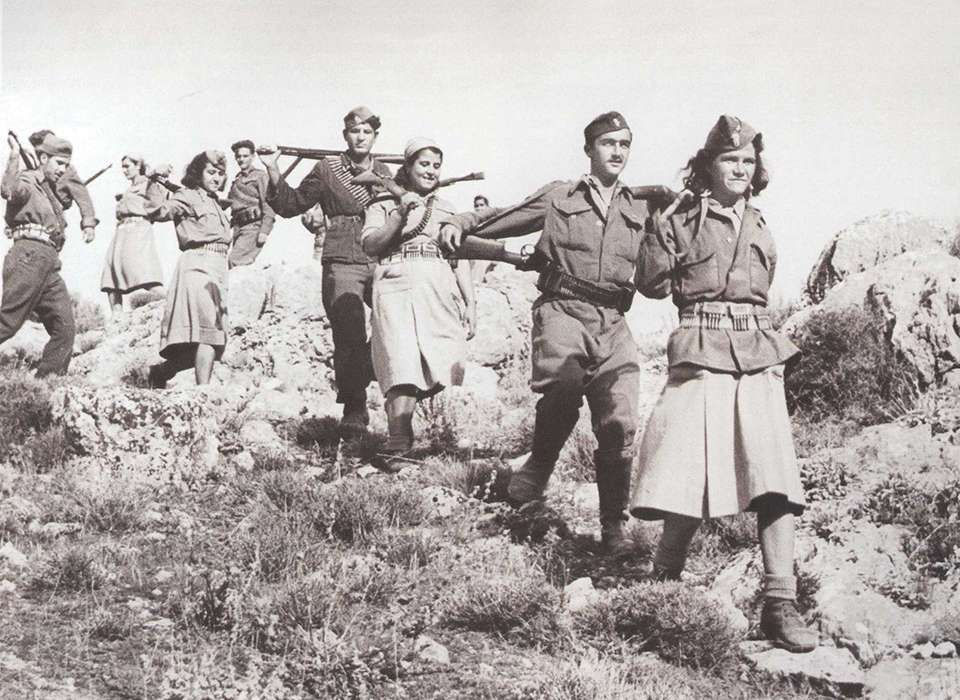
Greek ELAS Andartes, 1942

The second team, headed by Christopher Woodhouse, fared better. They landed seventeen kilometers north of Myers on the other side of Mount Giona. The four commandos landed without separation or injury. Soon Woodhouse’s team met, unexpectedly, armed men. The tension lifted when the andartes decided they were British and not German. The leader was a Greek who said he was expecting an explosive supply drop to blow up the retaining walls of the Corinth Canal. With him were two Cypriots, escaped prisoners of war.

The andartes led them to a village. There, Woodhouse, who went by Monty instead of Lord Terrington of Huddersfield, welcomed their equipment canisters retrieved by the villagers. But he watched in horror as children munched on the plastic explosive bars thinking they were fudge. They got sick but survived. Woodhouse, an Oxford-educated classics scholar and a fluent speaker of Greek, came first to understand the strangeness of occupied Greece, a country of scant resemblance to the land of Pericles.

Following the advice of a supportive villager the Woodhouse team moved to a cave on the eastern slopes of Mount Giona on a plateau called Prophet Elias. The cave was big enough to shelter all three commando groups. It was a three-day hike across a vast and rugged terrain. They trudged through deep snow in the valleys while the wind blew in gales cutting like the icy steel of a knife. Woodhouse welcomed Myers and his team and the two shepherds into their grotto sanctuary two days after arrival.

They knew the Italians were searching for them. The Italians had heard the Liberators on two nights. The SOE men moved to another cave that offered a better defense and tried to contact the third team.

The third team did not jump with the other two on September 30. They couldn’t spot signal fires and returned to Cairo. Three weeks later, they jumped blind and misjudged their location, dropping into the Karpenisi Valley near a large Italian garrison. Aris Velouchiotis commanded an EAM-ELAS unit that rescued the SOE team from certain capture. It took the three SOE teams a month to reunite.

Meanwhile, Woodhouse and Myers met the local EDES leader, Zervas, a short and rotund man of a carefree persona underlying his reputation as a brigand. Zervas controlled one hundred fighters. Later, they met Aris, the EAM-ELAS commander. He was thin, lanky, and hard-eyed, always alert and examining his surroundings. Aris commanded a larger, more disciplined force. His andartes controlled the territory on which rose the primary target of Operation Harling, the Gorgopotamos Bridge. But, before they could destroy one bridge, Myers had to build another.

To say EAM-ELAS and EDES were bitter rivals was to sugarcoat the reality. Both groups would not hesitate to attack and kill the other, given a provocation or a chance. Their politics clashed, and their leaders clashed. EAM-ELAS was the better organized and disciplined and larger. But British strategists fearing communist influence favored EDES. Myers and Woodhouse were to walk a diplomatic tightwire and forge a truce to carry out Operation Harling.

When they met with Aris of EAM-ELAS and Zervas of EDES, brandy helped to relax the grim Aris, and the carrot of arms and ammunition, and air support and resupply sweetened the proposition. Aris was less enthusiastic about the attack than Zervas. The EAM-ELAS top leadership believed that countryside military raids were less productive than urban actions. Aris was under orders “not to attack formed bodies of the enemy.”

Aris bucked EAM-ELAS leadership and agreed to take part. With the shaking of hands all around and toasts to the pact, EAM-ELAS and EDES pledged to work together for the attack on the Gorgopotamos Bridge. The British saw this arrangement as perhaps the start of a lasting reconciliation and a budding alliance between the organizations. But in Greece, the old is never far from the present.

Operation Animals set for June 21, 1943, called for an ambitious campaign of sabotage in Greece. SOE attacks with andarte support were to fool the Axis Powers into believing that Greece was the target of an Allied amphibious landing, instead of Sicily. Operation Animals was part of a broader campaign, Operation Barclay. This plan involved twelve fake Allied divisions, bogus troop movements, and corresponding fake radio communications. The deception was to fool the Germans into reinforcing Greece and forget about Sicily. Operation Mincemeat, the dead body, brought ashore in Spain, was part of Operation Barclay.

The British SOE commandos parachuted into Greece with three targets, bridges across the Papadia, Asopos, and Gorgopotamos rivers, all Roumeli railroad viaducts. Colonel Myers, while waiting to reunite with Woodhouse, reconnoitered all three and found Gorgopotamos Bridge the best choice.

Constructed in 1905 and considered an engineering marvel, the Gorgopotamos Bridge is ninety-five miles northwest of Athens. The bridge rises 112 feet to span the gorge and churning river for seven hundred feet. Gorgopotamos means the rushing river in Greek. Over it crossed a single line of railway, the lifeblood of Germany’s campaigns in the Balkans and North Africa.

As Myers crawled to his vantage at dawn, he could see through powerful binoculars the seven sub-linear spans supported by six pylons of the massive Gorgopotamos structure. The four central pylons were stone and would be impervious to the plastic explosives of the SOE. But iron piers, girders, and trusses supported either end. These would be the target for the four hundred pounds of shaped charges on the night of November 25, 1942.

One hundred Italians and five Germans guarded the bridge with pillboxes and heavy machineguns at either approach. With the SOE team of 12 and 86 fighters from EAM-ELAS and 52 from EDES, the attack would go forward with 150 fighters. The plan was simple, but the execution was treacherous.

Before 1100 hours, small groups of andartes went up the rail line both north and south to cut communications wires, halt advancing trains, and block any attempt at reinforcement. Then, at 1114 hours, all hell broke loose as the andartes attacked pillboxes at either end of the bridge. The southern position fell first with the Italians running to escape the attack. The northern defense fell when Myers sent his small contingent of reinforcements. As the attackers gained control of the bridge, the explosives team and eight mules made their way down the rough brush and slippery stones of the gorge. At the floor of the gorge, they waded into the powerful, unsettled currents of the river, and across a narrow plank bridge.

At the base of the bridge, the explosives team shaped and reshaped their charges and attached them to the girders. At 0130 hours on the morning of the 26th, the first explosion collapsed the two spans at either end of the bridge. The severed sections fell into the gorge with a crash to the cheers of fighters. An hour later, with explosives left over, the SOE sappers demolished the fallen spans where they landed. With the sky lightening at the hint of dawn, a green Very light spread an eerie glow on the gray-rose palate and signaled the retreat. The attackers withdrew at 0430 hours for a fifteen-hour trek to their hideout. The andartes suffered only four casualties and no killed-in-action. The SOE men were untouched and Myers estimated the Italian dead at thirty.

At the hideout, Myers expressed his gratitude to both Zervas and Aris. He told them the attack could not have been successful without them. Myers sent a messenger to Athens to arrange a supply drop of boots, clothing, arms, and whiskey for EDES and Zervas. Aris requested the same for EAM-ELAS, but Myers had no authority for the communist request. He instead gave Aris and EAM-ELAS 250 gold sovereigns. Myers told Zervas and Aris that he had recommended them for decorations and commended them for their service to the Allied cause. Zervas was grateful but Aris wanted none of it and told Myers he preferred boots for his fighters.

The German repair of the Gorgopotamos Bridge took six weeks, denying Rommel’s Afrika Korps two thousand trainloads of supplies. The repair to German respect for Italian courage under fire never happened. The Germans took over security for the entire railway system, straining their forces in Greece and the Balkans. Less than a month later, the 11th Luftwaffe Field Division moved into Attica north of Athens.

On December 1, 1942, ten villagers from tiny Ypati, hands bound, were marched to the rubble of the Gorgopotamos Bridge, and gunned down by the Germans. Four days later, the Germans killed another six hostages in the same way. It wasn’t the first blood retribution for the Germans in the administration of their doctrine of collective responsibility, and it wouldn’t be the last.

Hostage Wagons

After Gorgopotamos, the Germans added klouves or crates to their trains. The Nazis filled these open railcars fenced with barbed wire with innocent Greek civilians, mostly women, and children. They coupled the cars ahead of the locomotives and shoved them first in line to discourage attack. It is impossible to overstate Nazi barbarity. Their crimes of taking hostages, and retaliatory killings, were sickening. At the Nuremberg Trials following the war, the Greek government reported 91,000 Greeks murdered as hostages and 800 villages and towns destroyed by the German occupation forces. – SJH Copyright © 2019 Steven James Hantzis

Notes

[1] http://oss-og.org/

[1] http://nzetc.victoria.ac.nz/tm/scholarly/tei-WH2-2Epi-c2-WH2-2Epi-j.html page 24

[1] Assessing Revolutionary and Insurgent Strategies, CASE STUDY IN GUERRILLA WAR: GREECE DURING WORLD WAR II, REVISED EDITION, United States Army Special Operations Command, page 58.

[1] Myers, E.C.W. Greek Entanglement. Alan Sutton, 1985. https://books.google.com/books?id=NP1mAAAAMAAJ. Page 184.

[1] Churchill’s Ministry of Ungentlemanly Warfare, The Mavericks Who Plotted Hitler’s Defeat – Giles Milton, page 206.

[1] Churchill’s Ministry of Ungentlemanly Warfare, The Mavericks Who Plotted Hitler’s Defeat – Giles Milton

[1] Myers, E.C.W. Greek Entanglement. Alan Sutton, 1985. https://books.google.com/books?id=NP1mAAAAMAAJ. Page 43

[1] Assessing Revolutionary and Insurgent Strategies, CASE STUDY IN GUERRILLA WAR: GREECE DURING WORLD WAR II, REVISED EDITION, United States Army Special Operations Command, page 29

[1] Using Robotic Theodolites (RTS) in Structural Health Monitoring of Short-span Railway Bridges, P. Psimoulisa,b *, S. Stirosa, a Geodesy Lab., Dept. of Civil Eng., University of Patras, Patras, Greece – stiros@upatras.gr, b Geodesy and Geodynamics Lab., ETH Zurich, Schafmattstr. 34, Zurich, Switzerland – panospsimoulis@ethz.ch, page 1 https://www.fig.net/resources/proceedings/2011/2011_lsgi/session_1e/psimoulis_stiros.pdf

[1] Myers, E.C.W. Greek Entanglement. Alan Sutton, 1985. https://books.google.com/books?id=NP1mAAAAMAAJ. Page 44

[1] Assessing Revolutionary and Insurgent Strategies, CASE STUDY IN GUERRILLA WAR: GREECE DURING WORLD WAR II, REVISED EDITION, United States Army Special Operations Command, page 39

[1] Churchill’s Ministry of Ungentlemanly Warfare, The Mavericks Who Plotted Hitler’s Defeat – Giles Milton, page 218.

[1] German Antiguerrilla Operations in the Balkans (1941-1944), CMH Publication 104-18 page 19.

[1] Yada-Mc Neal, Stephan D.. Places of Shame – German and Bulgarian War Crimes in Greece 1941-1945. N.p.: Books on Demand, 2018. Page 137

[1] http://www.occupation-memories.org/en/deutsche-okkupation/Wichtige-Begriffe/index.html [1] http://www.occupation-memories.org/en/deutsche-okkupation/repressalien/index.html